
The Bhagavad Gita, Chapter 1, Verses 12 ...19
[In the previous verse, Duryodhana has concluded saying (to Drona), “All of you, standing in your respective positions at all the entrances to the army formation, should protect none other than Bhīshma.”]
Translation
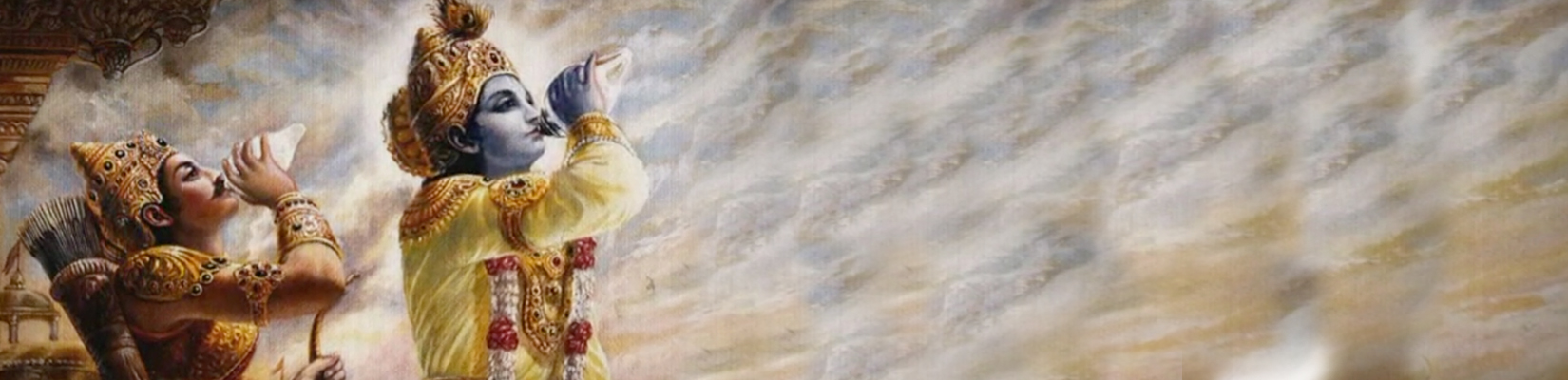
In order to lift his (Duryodhana’s) spirits, the mighty old Kuru patriarch (Bhīshma) roared aloud like a lion and blew a conch.
Annotation
Vyāsa is explicit in the verse that Bhīshma shouts and blows a conch to raise Duryodhana’s spirits, so we know he has been in low spirits. The old Kuru patriarch has perceived Duryodhana’s confidence is shaken after seeing the superbly organized Pāṇḍava army. He has now little trust in his army’s ability to fight the enemy. Bhīshma strives to create a lively environment and brighten and invigorate Duryodhana, who is now unsure of himself. Or has the wise old Kuru thought he should start the war before Duryodhana’s confidence drains away completely? But for sure, he missed a fleeting conflict within Duryodhana—a conflict between dharma and kāma (desire).
It is important to note that, by tradition, the first blowing of a conch on the battleground is for the Supreme Commander of the challenging army to do. In a battle, sounding the conch is the formal signal to challenge the opposing army. Here, Pāṇḍavas, the aggrieved, need to re-claim their share of the Kingdom from Duryodhana and so they should challenge the Kauravas. Bhīshma has pre-empted the Pāṇḍavas. What an unfortunate gesture!
Bhīshma perhaps does not recognize what really sapped Duryodhana of his confidence. What has hit him harder should be the realization, even if for a moment, that he is drowned in adharma (unrighteousness).
It is not an unfair assessment, therefore, to say Bhīshma has lost an opportunity to save Duryodhana as well as to avert a catastrophic war. The earlier verse has illustrated that Duryodhana has little recourse but to rely on Bhīshma alone as the cover to protect his interest. At this critical moment of distress, who else other than Bhīshma could have influenced Duryodhana to return to the path of dharma? An attempt was worthy of the Kuru patriarch. Instead, he has blown the conch. Alas, the war has become a reality!
Translation
Suddenly thereafter, conches, large drums, gongs, kettledrums, and horns were played together, making a loud, confused clatter.
Annotation
What Bhīshma did supposedly to cheer up Duryodhana turned out to be a tumult, creating an environment of total confusion.
Translation
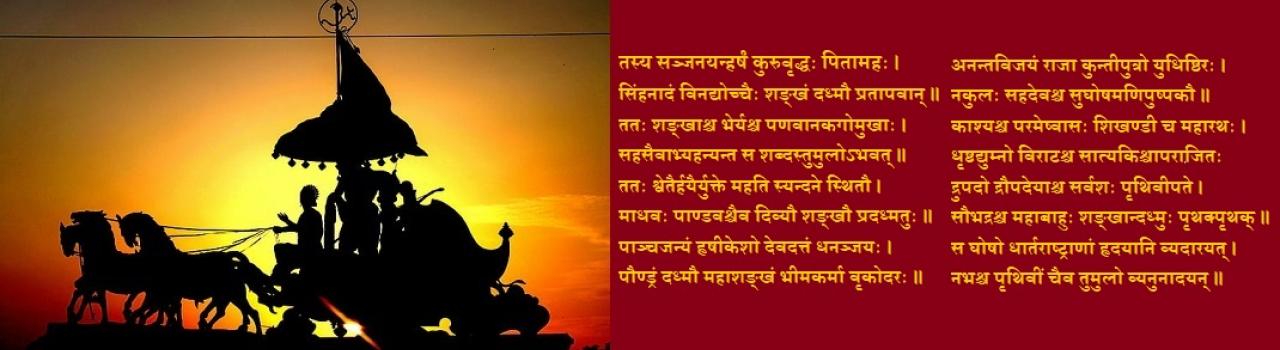
Then, Kṛshṇa and Arjuna, standing in their glorious chariot yoked to white horses, blew their divine conches.
Annotation
Here in this verse, the poet uses very simple qualifiers and transforms the mood and ambience altogether. The word mahati (महति), which describes the chariot, literally means great (or glorious). In the spiritual sense, the word points to Brahman. The white color of the horses transmits the message of peace (śānti) as well as purity. Vyāsa ascribes divinity to the two conches of Kṛshṇa and Arjuna by using the word divyau (दिव्यौ). ‘Divine’ is a translation for convenience, whereas, going by the meaning of the Sanskrit root, div (light), the word suggests the luminosity or effulgence of Brahman. Shifting the complete attention from the physical to these subtle aspects, we will discern an environment for spiritual instructions being set up by the Sage. Because both Kṛshṇa and Arjuna are the protagonists of the instructional session, the poet applies all the qualifiers to the two of them together. The presence of the white horses proclaims the ever-existing possibility of restoring peace. Sheer human ignorance blocks the view of the possibility.
The epithets, Mādhava and Pāṇḍava, used for Kṛshṇa and Arjuna, respectively, highlight the contrast between the Absolute and man* or dharma-śarīra and karma śarīra. When a person transcends karma śarīra and remains firm forever in dharma-śarīra, he/she merges into the Absolute ̶ experiences the oneness with Brahman.
[Notes: (1) *The word man is used to mean all human beings together, not just Arjuna alone. Further, we should remember considerations such as gender diversity are not relevant in the domain of Brahman. (2) Transcending karma śarīra does not mean to live without doing work; the Gita teaches later what it means.]
We read the next four verses together.
Translation
Kṛshṇa blew his conch-shell named Pāñchajanya and, along with him, Arjuna blew his conch named Devadatta. Then the following blew their conches in a sequence: Bhīma, his great conch Pauṇḍra, then King Yudhishṭhira, his conch, Ananta-vijaya, Nakula and Sahadeva, their conches named Sughosha and Maṇipushpaka, respectively. Further, the king of Kāśi, Śikhaṇḍin, the great-chariot-warrior, Dhṛshṭadyumna, Virāṭa, the unconquerable Sātyaki, King Drupada, the sons of Draupadi and the mighty-armed Abhimanyu blew their conches. O King, they all blew their conches one by one in perfect order.
Annotation
We note the high level of order and discipline on the side of the Pāṇḍava army. It symbolizes the chaos-free domain of dharma or Brahman. Again, we see the sign of the forthcoming spiritual teaching.
We need not carry an impression that the Pāṇḍavas are perfect at the level of absolute dharma. They are good, have come here to fight a battle, demanding a long denied justice. No doubt, their demand is of fundamental importance in the relative world. Here, a fact of supreme importance is that wars take place in the world when the rulers do not conform to Kshatriya Dharma. [One may point out Kshatriya and Kshatriya Dharma are systems existed in India. How can we generalize and apply it to the entire world? Sage Vyāsa uses the existing terminology to describe a universal principle of governance based on dharma. A deeper look will show the word Kshatriya has indeed an overarching implication. According to him, a way of living following Yoga Śastra, as taught in the Gita, is the method to ensure proper Kshatriya Dharma, and peace in the world as its outcome. We will soon discuss the details and recognize Kshatriya Dharma and absolute dharma have a close relation and the two are of the realm of Brahman.] While the Pāṇḍavas are virtuous Kshatriyas, they have their shortcomings in observing Kshatriya Dharma, as Kṛshṇa brings out in the Gita. In the domain of Brahman, the system of Danda (part of a later discussion) takes precedence over the human made laws of justice.
We have mentioned earlier that someone (or something) sits inside every one of us as a witness to whatever happens in and around us. This is an important concept in Brahma-vidya. The witness inside all of us is nothing but Brahman, which exists as absolute dharma as well; the two are not different. This explains why our body has the potential to act as dharma-śarīra.
On the Pāṇḍava side, Kṛshṇa has been the first to blow his conch, Pānchajanya. He has no business in the war since he declared at the outset that he would stay unarmed on the battlefield. As promised, he has come unarmed, in the role of Arjuna’s charioteer. [We may recollect that he presented two separate offers of his support before Duryodhana and Arjuna to choose from ̶ one was his powerful army and the other himself, unarmed.]
Kṛshṇa, who stands unarmed at Kurukshetra, just witnesses what happens between the Pāṇḍavas and the Kauravas, and he thus symbolizes Brahman or dharma. And from the Pāṇḍavas’ side, he has blown his conch first! In the realm of Brahman, there are no conflicts, wars, killings, etc. Then, why has he sounded his conch? Is the conch sound a call for war? Only Kṛshṇa, from the beginning to the end, worked persistently to restore peace between the two factions. Duryodhana a little earlier has mentioned that the Pāṇḍava army is well protected by Bhīma (bhīmābhirakshitam); so he stands in front, at the main entrance to the Pāṇḍava army formation. But Vyāsa places in our minds Kṛshṇa, the peacemaker, in front, and makes him blow his divine Pānchajanya. In the sound of the divine conch, do we not hear another call for peace?
Translation
The resonance of that booming sound, reverberating between the sky and the earth, rent the hearts of the sons of Dhṛtarāshṭra.
Annotation
The sons of Dhṛtarāshṭra (the Kauravas), with their dharma-śarīra totally obscured, stand oblivious to the message of peace conveyed by Kṛshṇa. They could see only the petrifying threat in the systematic but booming sound of the conches that quaked the earth and quivered the sky.
The poet sends a message to the world that the revival from the present level of decadence of dharma (righteousness) and values is a mammoth task which shakes the earth and heaven.
-----------------
(To read the next post [Gita Post #8] click/tap on this link: https://www.ekatma.org/node/186)
If you have not subscribed yet,
Comments (2)
Very interesting interpretation. Not heard of this before
Yes Subbu. The humble attempt is a new way of interpreting, which explains some of the apparent paradoxes in the Gita.
Namaste!
Leave a comment