
The Bhagavad Gita, Chapter 1, Verses 31 ... 36
Translation
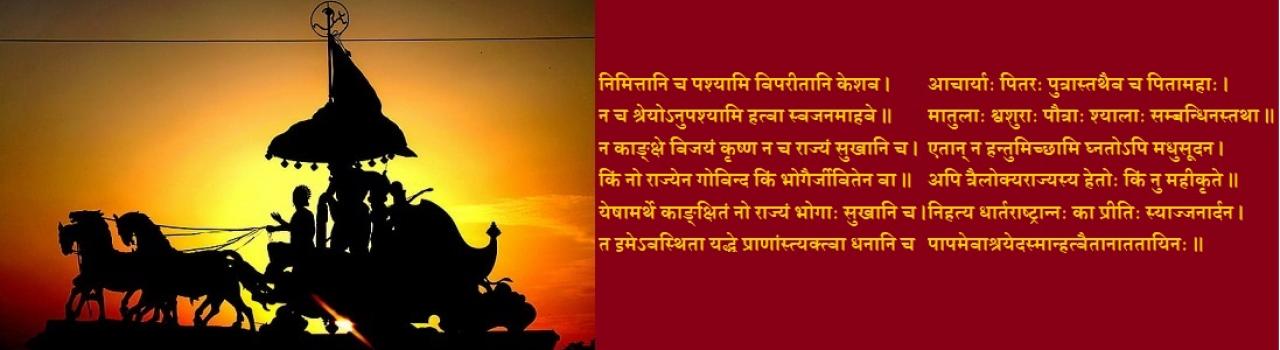
O, Kesava (Kṛshṇa), I see contradicting portents too and I do not foresee any virtuous gains (śreyas) at all from killing my own men (svajanaḥ) in war.
Annotation
Arjuna says he sees contradicting portents [viparītāni nimittāni (विपरीतानि निमित्तानि)]. He came to the battlefield with his own dreams of achievements. Now he finds it astonishing that nothing meritorious is here to achieve. “Instead, I am here to murder my own men assembled in millions!” This contradiction causes further confusion for Arjuna. The very notion that there are enemies in the world is missing in him at present. He continues to see the multitude of soldiers as an undifferentiated whole. All over the battleground, he finds his own men. This verse confirms Sañjaya’s reading of Arjuna’s vision of svajanaḥ (my own people) in everybody.
We should note the word śreyas Arjuna uses. It is an important hint about his present state. He is not suffering from any mental disorder as described by many commentaries. He is in distress, at the moment, for a reason obvious to us, but not to him; and he recovers after a while. Śreyas in reality means the supreme good or value one can aspire to gain in life. It belongs to the domain of Brahman, the Absolute. As the verse suggests, he now looks for śreyas. The urge to use the discretion occurs in people of genuinely healthy minds. For the rest, worldly gains (preyas) are the prime consideration. That means a dramatic change in Arjuna’s notion of achievement has taken place in the last few moments. What he considered achievement earlier is not what he contemplates now. The reason for introducing the word śreyas will be clear as we progress.
We should read the next two verses together for a full understanding of Arjuna’s thought process.
Translation
I do not desire victory, O Kṛshṇa, nor kingdom, nor well-being. What do we gain from kingdom, O Govinda (Kṛshṇa)? What is enjoyment or even life for us when all the people, for whose sake we have desired the kingdom, enjoyments, and well-being, are standing here in battle, sacrificing their lives and wealth?
Annotation
In verse 31, when Arjuna has declared that he does not see gaining any śreyas (virtuous gains) by winning the war, he has implied what he says in these two verses that we review now.
In the present state of mind, Arjuna says his desire for the kingdom, enjoyments, and well-being are indeed for the sake of the citizens of the kingdom. He refers to all the people gathered there on both the armies and speaks these words. He does not find any meaning in such worldly gains for himself. His consideration shifts entirely to the well-being of the world represented by the four million people on the battlefield. It is in their well-being he sees śreyas (virtuous gains). When one visualizes śreyas in universal well-being, the meaning of śreyas assumes a different dimension. This state of mind once again confirms the influence of para (the Transcendental) on Arjuna.
Another noteworthy change is the inclusive ‘us’ Arjuna uses in the two verses! His words mean, "we alone, without svajanaḥ, have nothing to gain from the kingdom; enjoyment, or even life has no meaning in the absence of the total well-being of the world, of which we are only inseparable parts."
[Arjuna sees the world as a single family, or full of replications of his own self. That is the vision of svajanaḥ.]
Translation
O Madhusudana (Kṛshṇa), even if I am killed, I do not wish to kill these teachers, fathers, sons, and also grandfathers, maternal uncles, fathers-in-law, grandsons and brothers-in-law, and similarly the family men, even if I am to gain the supremacy of the three worlds ̶ why then for the sake of the earth?
Annotation
We, the Gita students, can take this verse as an opportunity for us to verify whether Sañjaya has been correct in his understanding of Arjuna’s thoughts and feelings. Arjuna himself mentions all the relations in plurals as Sañjaya has done earlier! Further, Arjuna’s words make it explicit that he covers his relatives or family men in the end separately by using another word sambandhinaḥ (सम्बन्धिनः). The tone of the verse implies the family men are just a subset of the svajanaḥ he visualizes in the entire crowd on the battlefield. We have, thus, convincing evidence that the many relations he mentions in plurals do represent the rest of the two armies and not his family men.
Arjuna is emphatic in his words that he does not want to kill anyone, even if he gains the lordship of all the three worlds, let alone a kingdom on earth. (The three worlds refer to those the Vedic tradition deals with, namely the earth, the heaven and the lower world called pātāla.)
Vyāsa, in these few verses, uses the words sambandhinaḥ (सम्बन्धिनः) and svabāndhāvan (स्वबान्धवान्) to denote people of blood relations or relations by marriage. So it is obvious the two words refer to everybody from the Kuru family (both the Kauravas and the Pāṇḍvas). The word svajanaḥ is used in this chapter in a universal sense far beyond blood/family relations. By svajanaḥ, from a philosophical point of view, the poet implies all human beings of a common Self, Brahman.
Translation
After killing the sons of Dhṛtarāshṭra, what happiness will we have, O Janārdana (Kṛshṇa)? Only sin will come upon us if we kill these ruthless sinners.
Annotation
Arjuna uses a strong word, ātatāyinaḥ (आततायिनः), to describe Duryodhana and his brothers. We have translated it as ruthless sinners, or maybe more appropriate to say ruthless criminals. By definition, the word ātatāyinaḥ is used to denote people who commit six kinds of evil deeds such as setting fire to others’ houses, poisoning others, carrying always weapons intending to kill others, stealing others’ wealth, grabbing others’ farmlands by force, and molesting other men’s wives.
The Pāṇḍava brothers have been victims of many heinous crimes of the Kauravas, so Duryodhana and his brothers are only fit to be classified in the category. By the prevailing law, a person in the category can be instantly killed if he is sighted anywhere. But Arjuna, in his present state of kshudra samādhi, realizes even killing such dangerous criminals will only make one a sinner (pāpi). He talks as though he was an avowed supporter of ahimsa (non-killing). Jñāneśvari makes a remark, “... the advent of feelings of peace for the time being completely overlaid the warrior qualities of Arjuna.” Let us note that Jñāneśvari also considers the change in Arjuna a temporary one, so it says, “feelings of peace for the time being.”
Until the previous verse, Arjuna has expressed his concerns for all the people gathered there, with a compassion and love that is universal. He does continue to feel the same compassion, but now he expresses his disappointment that the sons of Dhṛtarāshṭra have been ruthless criminals. The significant aspect for us to note in Arjuna is that he is now against killing even the worst of criminals. This is a rare attitude seen in the relative world, but the perfect perspective or vision in the transcendental domain; in the domain of Brahman, the worst of criminals are also the manifestation of the same Self! No wonder, in the passing mystic state, Arjuna counts the sons of Dhṛtarāshṭra (the Kauravas) as integral to his vision of svajanaḥ (own men), although they have been of deplorable criminal traits.
The fleeting experience of samādhi Arjuna undergoes is not unknown to an advanced seeker of Reality, but he has never been one. His ignorance in that realm is obvious because he says he is against killing those criminals for the fear of becoming a sinner (pāpi) himself! Non-killing or ahimsa is correct dharma, whereas his reason for not killing is inconsistent with the philosophy of the Gita. Arjuna’s explanations and arguments in the rest of the chapter are of a similar kind. The author of the Gita illustrates he is not firm at all in the realm of the Absolute like a yogi who can stay steady forever in the perfect yogic state, whereas Arjuna is just in a passing mystic state. So, we find in the subsequent verses he mixes up his transient vision of the domain of the Absolute and the ill-judged wisdom gained from the relative world.
-----------------
(To read the next post [Gita Post #11] click/tap on this link: https://www.ekatma.org/node/189)

Comments (2)
Beautiful description and analysis of Arjuna's state of despondency. Thank you Baiju for such insightful annotations.
Thank you very much. Namaste!
Leave a comment