
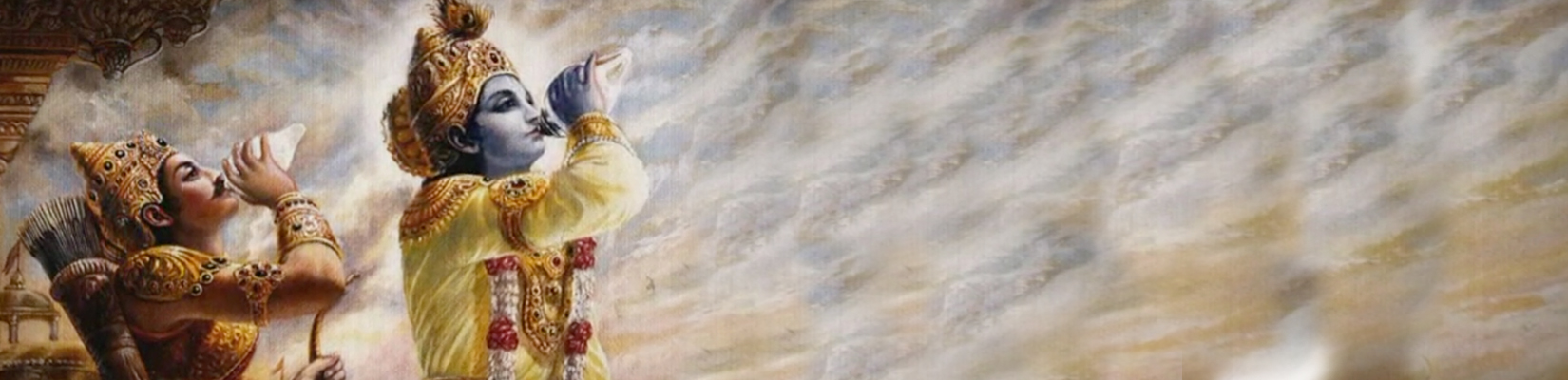
Arjuna, the Disciple in the Bhagavad Gita
Gita Post #15
[Arjuna ended his words saying: My vitiated mind, lacking the discriminating wisdom, is bewildered owing to my incompetence at dharma. So I would ask you to reveal that which is definitely of supreme merit (śreyaḥ) to me. I am your disciple. Instruct me who has taken refuge in you. Even if I am to gain the unchallenged, prosperous kingdom on earth or even the supremacy over the gods in heaven too, I see not that which relieves my distress that burns the senses.]
Translation
Sanjaya said: Having spoken thus to Hṛshīkeśa (Kṛshṇa), Guḍākeśa (Arjuna), the Terror of Enemies, said to Govinda (Kṛshṇa), “I will not fight” and remained silent—what a surprise!
Annotation
Arjuna is determined, “Without knowing that which is supremely meritorious (śreyaḥ) to me, I am not going to move.” The exclamation is about this resolve of Arjuna. It is rare to see such preparedness to seek wisdom on the spot, despite being in the middle of the two fighting armies.
Sañjaya uses two epithets of Arjuna to give hints to Dhṛtarāshṭra: He is Conqueror of Sleep (Guḍākeśa), so he will be back soon from his trance (kshudra samādhi). He is Terror of Enemies (Parantapa), so the sons of Dhṛtarāshṭra will have a terrible time when he stands up and fights.
We have discussed the way to understand Kṛshṇa in the context of Vedanta and Brahma-tattva (the doctrine of Brahman). [To read again, click/tap on this link: Understanding Kṛshṇa; to read Brahma-tattva, click/tap on this link: Brahma-tattva.] Further, it will help us if we also gain a decent understanding of Arjuna as a student of Brahma-vidya before Bhagavan Kṛshṇa begins to instruct him from verse 11 onwards. As we labour to find the answer to the conundrum presented by Arjuna’s strange behaviour, a thorough discussion of his intellectual bent will be of immense benefit. Leaning on the accepted Vedantic principles, we present here an assessment of Arjuna’s propensity for spiritual quest.
Arjuna, the Disciple in the Bhagavad Gita
In the Bhagavad Gita circles, we hear a majority opinion that Arjuna was an outstanding disciple (if not the perfect one) to absorb the philosophy Vyāsa expounds in the Bhagavad Gita. Further, many Gita followers believe what he did after his dialogue with Kṛshṇa was also in line with the philosophy of the Bhagavad Gita. The former impression leads one to this weird conclusion. Here almost all lose sight of the freedom the scripture allows us to think that Arjuna did not grasp Brahma-vidya. His decision in the end to fight the battle is no more misleading, if we think in that direction.
The philosophy Arjuna listens to is so profound that it aims at the highest spiritual achievement ever possible for a human being. Immediately after listening to that philosophy, if Arjuna fights a bloody battle that kills millions of soldiers, who is to blame? The philosophy or the disciple?
We should put a little effort, therefore, into understanding Arjuna better, for we will then gain better precision and higher conviction in the philosophy lessons we learn.
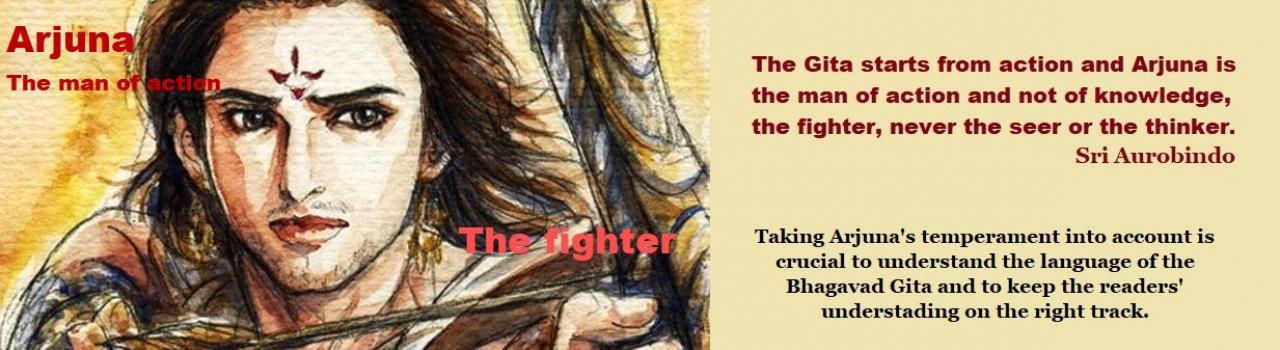
In the recent centuries, Sri Aurobindo was one of the few who have done a deep study of the Bhagavad Gita and published groundbreaking insights that benefit the Gita learners. His analysis of Arjuna’s temperament and fitness to be the disciple in the Gita is quite exhaustive. [Essays on the Gita - The Human Disciple by Sri Aurobindo] Overall, he has a lenient view of Arjuna’s abilities, but he makes several insightful observations that give us better visibility of his personality. Here are a few of his observations:
(1) “In the Gita he (Arjuna) typifies the human soul of action brought face to face through that action in its highest and most violent crisis with the problem of human life and its apparent incompatibility with the spiritual state or even with a purely ethical ideal of perfection.”
(2) “But the Gita starts from action and Arjuna is the man of action and not of knowledge, the fighter, never the seer or the thinker.”
(3) “They are not the thoughts (Arjuna’s thoughts in the Gita, Chapter 1), the standpoint, the motives of a philosophical or even of a deeply reflective mind or a spiritual temperament confronted with the same or a similar problem. They are those, as we might say, of the practical or the pragmatic man, the emotional, sensational, moral and intelligent human being not habituated to profound and original reflection or any sounding of the depths, accustomed rather to high but fixed standards of thought and action and a confident treading through all vicissitudes and difficulties, who now finds all his standards failing him and all the basis of his confidence in himself and his life shorn away from under him at a single stroke.”
Arjuna is thus
(a) Not of a philosophical mind
(b) Not of a deeply reflective mind
(c) Not of a spiritual temperament
(d) Not habituated to profound and original reflection or any sounding of the depths
He is “accustomed rather to high but fixed standards of thought and action and a confident treading through all vicissitudes and difficulties….”
The prime motive of a hero such as Arjuna is to remain steadfast in the path of justice, which is of high value in the relative world. Arjuna and his brothers were wronged by the Kauravas. Despite being the victims of horrific crimes for decades, they showed extreme forbearance and forgiveness. They were at their wits’ end before they went for a war. In any court of justice, they had a genuine case in their favour, but the Gita teaches the philosophy that takes humans beyond the considerations of justice in material life. Of course, the Gita does not justify crimes of any kind, but the realm of the ultimate Reality, Brahman, is beyond the relative world of justice and injustice. Here is how we need to judge: If Arjuna cannot endure the pains inflicted by injustice, remain unaffected by the adversities, he is not really a seeker (of Brahman).
In the Upanishadic tradition of ancient India, the qualifying standards suggested for the wisdom seekers helped ensure effectiveness in achieving their end goal. Śaṅkarāchārya in his Viveka-chudāmaṇi summarized them in four qualities (Sādhanā Chatushṭaya) required of a wisdom seeker. They are:
1) The ability to discriminate between the eternal and the transient: Śreyas refers to the eternal and preyas the transient. [Śreyas: The highest value one can aspire to in life ̶ the wisdom of the Absolute or Brahman. Preyas: it is the aggregate of worldly values, comprising all material gains, worldly pleasures, etc.] Śaṅkara’s Sanskrit term for this capability is nityā-anitya viveka.
2) Being detached from the transient: It is the state of a person who becomes completely unaffected by the attractions of the world; it means, the sense organs and mind remain passive, undisturbed, when the seeker faces the worldly objects of pleasure, which generate affection. In Sanskrit, it is vairāgya.
3) Following these six disciplines as regular habits:
i. Śama: Practicing withdrawal of mind from all worldly objects of pleasure and reaching perfect calmness of mind, with a full focus in the only goal, Brahman.
ii. Dama: Withdrawing all the five sense organs (jñānedriya) and the five organs of actions (karmendriya) from the worldly objects that attract the senses; it means bringing these organs to their neutral position.
iii. Uparati: Not dependent on the external: It says that a seeker should not become attached to nor affected by anything (or anybody) external because no external things will help attain the wisdom of Brahman. One has to turn oneself completely inward. Dependence on external things will help only in worldly transactions but not in achieving the spiritual goal; rather, the external things work against the spiritual goal.
iv. Titikshā: It is the endurance of all suffering with equanimity and no vengeful thoughts; it is also the preparedness to take afflictions of body or mind, owing to the words and deeds external to oneself, with no anxiety and regret, nor any desire for redress.
v. Śraddhā: It is the positive attitude that takes the teachings of Śruti (Upanishads, etc.) and the instructions of the Seer-Guru as statements of Truth. It works only when the seeker is convinced that the ultimate Truth is not sense-perceivable and the wisdom of the Seer-Guru alone can help attain That ̶ the dependable sources of wisdom are the Seer-Guru and Śruti.
vi. Samādhāna: It is the state when the seeker’s intellect is convinced that Brahman alone is the Supreme Value he/she should aspire to; it involves the spontaneous focusing of the seeker’s awareness always in the thought of Brahman, never allowing the mind to go after the objects of pleasure.
4) Mumukshutva: It is the fervent desire to free oneself from the attachments to the transient world (and worldly suffering); it also means returning to one’s own true nature, which is Brahman.
It should be obvious now that we cannot consider Arjuna a person of spiritual inclination by nature. So we have attributed the abrupt change we observed in him to a mystic experience, which is also supported by the poet’s suggestion in the phrase parayā āvishṭah. His inability to contain the distress he suffered shows he was not a person of titikshā (enduring all suffering with equanimity). If we recollect how he conducted his twelve-year pilgrimage, we recognize he was not a person who could practice vairāgya (being completely unaffected by the worldly objects of pleasure), even in a limited way; nor was he a person of Śama, Dama or Uparati. [Pilgrimage is a spiritual practice advocated by many masters to prepare the seekers for the higher wisdom; perhaps, it will be interesting now to re-read the account of his pilgrimage; to read again, click/tap on the link: The Summary of the Mahābhārata–Part 2]. Those who consider the Bhagavad Gita a mere holy text to be worshipped and chanted rather than the ideal philosophy to live by may have difficulties in accepting these facts. Let us note that as we approach the instructional sessions of the Gita, the mythological atmosphere of the Mahābhārata changes to one of śastra (spiritual science) and pure wisdom. All along the story, the poet has exposed the true strengths and shortcomings of the character of Arjuna and then designed the Bhagavad Gita dialogues for him and Kṛshṇa with absolute mastery. Unless we understand those strengths and weaknesses of Arjuna, we will struggle to decode the subtle imports of those dialogues.
Why did then Vyāsa choose Arjuna to be the disciple? It is impossible to speculate on the decisions made by the unparalleled genius of the Ṛshi. Yet, out of sheer intellectual curiosity, we should attempt our own analyses that do not harm in any way the underlying philosophy.
Was any other character in the epic a better fit to be the disciple? After the devastating battle of Kurukshetra, the king-designate Yudhishṭhira was overcome by remorse and began wailing for the unpardonable crime he had committed. He wanted to renounce everything and leave for the forests to live the life of a sannyasin. At one point, he went to the extent of proposing to end his life. The other Pāṇḍava brothers and Draupadi attempted to dissuade him from his drastic decision; they tried to justify the victory. Let us take a glance at the reply Yudhishṭhira gave to his brother Bhīma on that occasion [The Mahābhārata, Śanti Parva, Chapter 17]:
“If you keep adding fuel to the fire, the flames will shoot high into the sky, but when it is starved of fuel it extinguishes own its own. You, therefore, extinguish the fire in your stomach, as it appears, with little food. [Bhīma is characterized as one of gargantuan appetite; and appetite is symbolic of desire (kāma) for worldly values such as wealth and sense-gratifying pleasures.]
“He who is unwise does endless slaying for the sake of his stomach (kāma or desires). Conquer your stomach first. Then the conquered earth will serve as the means for you to win the unconquerable śreyas (the Supreme Value or the permanent good).
“By tapas (meditation), by brahmacharya (the pursuit of the path of Brahman) and by svādhyāya (learning Brahma-vidya or Yoga Śastra), the great ṛshis relieve themselves of the attachment to their bodies and enter the region to which death has no reach. Worldly objects of pleasure are the root of all attachments; they themselves are the origin of all karma (actions) as well. One attains to the supreme region of śreyas (paramapada) by being freed from those two sins (pāpa) ̶ attachments and karma.”
Those excerpts are from Yudhishṭhira’s counter to Bhīma’s justifying their victory in the battle, which was a gruesome massacre that exterminated the entire soldiers on both the armies. It is important for us to note that Yudhishṭhira did possess those qualities Sri Aurobindo missed in Arjuna. He was the leader of the Pāṇḍavas, and the symbol of dharma in a world where adharma (unrighteousness) had overpowered the human mind. And, after Kṛshṇa, Yudhishṭhira was the most significant character in the epic. Yet, Vyāsa did not picture him as the disciple in the Gita. Instead, he composed the story of a unique friendship that developed between Kṛshṇa and Arjuna over a long period; and then brought them together on the battlefield where the Gita dialogue was to take place.
What would have happened if Yudhishṭhira were to be the disciple of Kṛshṇa in the Bhagavad Gita? He would have been a perfect disciple to imbibe Yoga Śastra, and in the end would have called off the battle! The story would have thus ended there or taken a different course altogether. The Mahābhārata is different in style from the story of Rama. Vyāsa told a different tale because Time (Yuga) changed from Rama’s Treta Yuga to the end of Dvāpara Yuga. The Ramayana presents the story of the King who could operationalize dharma because he won over the unruly sense organs (became jitendriya) and overcame the terribly powerful kāma (desires). In contrast, Vyāsa illustrates in the Mahābhārata every detail of the wickedness the world witnessed when the Kshatriyas (rulers) became the slaves of their desires for worldly pleasures.
We surmise, therefore, the battle was an important event in the plot Vyāsa constructed for the epic. That being the case, what are the key aspects to be tied together? Our simplistic view could be summarized thus:
- The philosophy of the Absolute (Brahma-vidya) must be presented when the epic reaches its climax, for Brahma-vidya or Yoga Śastra is the key to re-establish dharma in the world—the very theme of the epic.
- The disciple in the Gita dialogue cannot be a person like Yudhishṭhira. The story must continue in a particular direction to produce the desired impact. The story needs war. And a story can afford to have a bloody war.
- The disciple, not a devout seeker by nature, must initiate a conversation that leads to the teaching of Yoga Śastra. Then Kṛshṇa takes over.
- The Yoga Śastra to be taught on the battlefield has ahimsa (non-killing) as a basic tenet. The epic itself upholds ahimsa as supreme dharma. It implies that the Yoga Śastra to be taught has no place for the battle.
- The disciple must be an avid, curious listener all along. However, he must be of a non-contemplative temperament, therefore slow in absorbing the essence of the philosophy (Yoga Śastra). But the teaching should completely address the needs of genuine contemplative seekers of wisdom; the chosen disciple should miss the essence and instead, he must be motivated to fight the battle.
Even our simplistic view of the problem statement looks complex to handle.
Why was the war a key event in the epic? One plausible explanation: The story must continue in a direction to produce a tempestuous churn in the minds of the thoughtful readers. Witnessing the horrifying war and its aftermath, they should undergo internally a cathartic experience and desperately yearn for a thread to cling on to ̶ one that offers a new lease of life. Vyāsa expected the readers to discover in the Gita the solace of their life. The picture of Yudhishṭhira writhing in absolute mental agony, induced by the aftermath of the war, is perhaps the most significant post-war illustration depicted by the poet.
We observe the scrupulous attention paid in characterizing Arjuna as the right fit for the disciple the poet wanted. Few persuasive ways we see to get Arjuna to start the dialogue of the Bhagavad Gita, keeping still the formula we have just described intact. The poet should employ a special technique that takes Arjuna to a philosophical mood of a reflective psyche. We know he is, in reality, not a person of that disposition (Sri Aurobindo’s studied remark). The technique the poet chooses must be nothing less than one of a magical or a supernatural power. A ṛshi has no difficulty at all to visualize Arjuna falling into a trance, a short mystic experience (kshudra samādhi). It is easier in the rarest of the rare occasions when Sri Kṛshṇa, the personification of Brahman, accompanies Arjuna as his charioteer ̶ a moment the battlefield becomes the domain of Brahman! It is a fleeting samādhi Arjuna goes through; when out of it, he is the same old heroic warrior who fights the battle with no compunction.
The assessment we make here of Arjuna may sound non-standard compared to the centuries old common beliefs. This will not affect in any way the Yoga Śāstra we learn. Rather, a logical assessment makes our Gita lessons much smoother. In order to test the veracity of our judgment, we cite here another related episode from the Mahābhārata, a very significant one in this context; then we conclude this discussion.
In a later section of the Mahābhārata, it is intriguing to listen to Arjuna telling Kṛshṇa that he forgot completely the Yoga Śastra he had taught him on the battlefield. He did not remember a word of the precious life-changing philosophy! Is it not thought provoking? Even after receiving the supreme wisdom of the Absolute directly from the Absolute, Arjuna remained himself a man of pure transactional life. Vyāsa wanted the readers to recognize that the efficacy of the study of Yoga Śastra depends solely on one’s conviction and the natural inclination to adopt the philosophy in one’s life.
Kṛshṇa, the embodiment of universal love and wisdom, answered, “Arjuna, that day you received from me the lessons in wisdom, the greatest of secrets indeed, as well as the principle of absolute dharma. You do not remember the lessons now because you could not comprehend my instructions. It is disheartening to me. I cannot recollect everything in the same way as I taught you. I am certain that you lack śraddhā (faith in guru’s words and in śruti or Upanishadic teaching). And your ability to hold your intellect (buddhi) firmly on the Self is weak. Arjuna, when I taught you the doctrine of Brahman, I was yoga-yukta (in a perfect yogic state). Those instructions were thorough and total for a person of śraddhā to become a knower of Brahman. Since I am not in the same state now, I cannot repeat all the instructions verbatim nor in the same form did I give you then. However, I shall narrate an ancient legend, which reveals the wisdom of Brahman; this will help you attain perfection. Listen carefully to all that I say with a well-balanced intellect.” [The Mahābhārata, Aśvamedhika Parva-Anugīta Parva, Chapter-16, *Verses 9-14]. What Kṛshṇa taught Arjuna in this episode is Anugīta.
That quote from the Mahābhārata supports an assessment that Arjuna lacks a natural inclination towards spirituality. We, however, should not think Arjuna was a person of an inferior intellect, rather he was the most brilliant among all the princes and he possessed a unique ability to apply every faculty of his mind and intellect where he wanted to excel. And he did excel. We should take advantage of this discussion only to recognize that the mental make-up and preparedness to absorb Brahma-vidya or Yoga Śastra are entirely different from those of the people who want to excel in the ever-competing situations we encounter in the world every other moment. There is a world of difference between the “ability to hold your intellect (buddhi) firmly on the Self” and acting with high intelligence.
As the Mahābhārata story goes, Arjuna never became a knower of Brahman. That should be no concern at all for us because the poet did not want him to be a Brahma-jñāni. But the Sage wanted the world to place themselves as listeners of Kṛshṇa's instructions. From the just quoted passage of the Mahābhārata, we, the Gita learners should keep the following assurance of Kṛshṇa (and Vyāsa) on top of our minds, “Those instructions (of the Bhagavad Gita) were thorough and total for a person of śraddhā to become a knower of Brahman (Brahma-jñāni).” The keyword is śraddhā .
[To read about śraddhā, click/tap on the link: Śraddhā]
Note:
*The original Sanskrit verses of the Mahābhārata passage we quoted towards the end of our discussion are as follows [The Mahābhārata, Aśvamedhika Parva-Anugita Parva, Chapter-16, Verses 6 and 9-14]:
--------------------
(To read the next post [Gita Post #16], click/tap on this link: https://www.ekatma.org/node/195)

Comments (2)
Interesting and distinct take on Arjuna. Thanks for providing context for the interpretation/understanding of Gita.
Thanks, Murthy. Namaste!
Leave a comment